
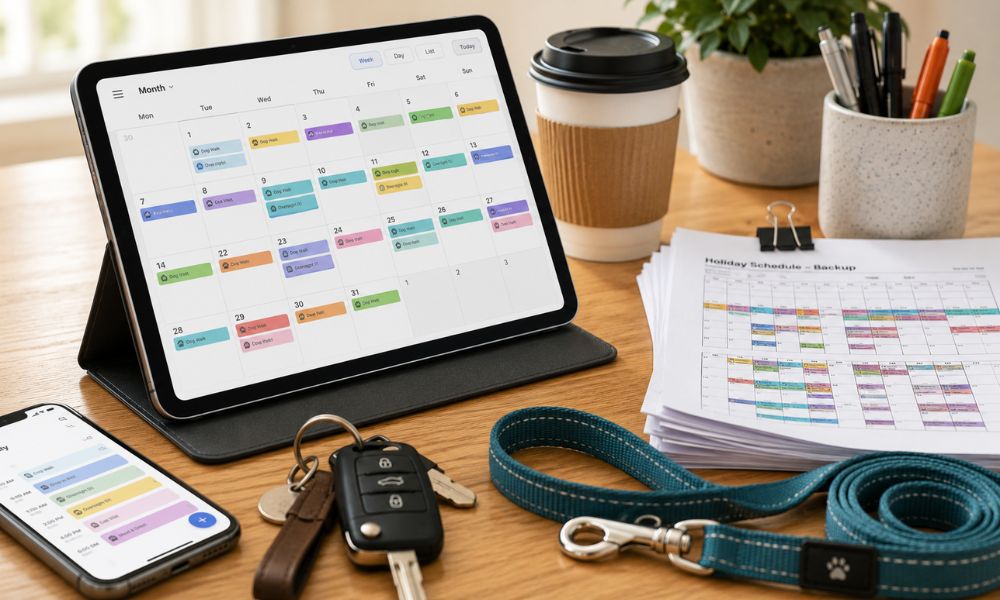
Peak holiday seasons like mid-summer and December are the ultimate test for a pet-sitting business. Demand skyrockets, calendars fill up, and your income potential is at an all-time high.
But there’s a catch. When you are operating at 200% capacity, your room for error drops to zero. A single app glitch, a traffic jam, or a forgotten medication instruction can turn a profitable week into a logistical nightmare.
The most successful pet sitters don’t just survive the holiday rush by working harder—they survive by setting boundaries and building bulletproof systems. Here is how to maintain an excellent service when you’re at your busiest.
1. Knowing when to say NO
It can be hard to turn down work in business, but the key to surviving your peak season is to know when to turn down a booking. Many sitters make the mistake of trying to squeeze in just one more booking. But peak season is exactly when service quality drops if you overextend yourself.
Before the holiday rush even begins, calculate your absolute maximum number of daily visits. When you hit that number, the door is closed.
- Depending on your service area, don’t forget to include travel time as that can double the time it takes for a visit
- Start a waitlist which you can use instead of a flat “no” to late enquiries from regular customers. Structure the by geographic zones so that if a cancellation pops up or an existing booking shortens, you can seamlessly plug in a nearby waitlisted customer without adding extra mileage to your day.
- Establish a strict cutoff date (e.g., three weeks before a major holiday) after which you absolutely refuse to onboard new, unverified customers. Peak season is not the time to gamble on an unknown pet with potential behavioural or separation anxiety issues.
- Protect your schedule for loyal, year-round clients. Politely turn down unknown holiday enquiries once your threshold is reached.
- Keep one or two slots open in case a customer’s flight gets delayed or a pet has a medical issue, as you’ll need that extra time to react without throwing off your entire day.
2. Work smarter (not harder) with updates
This is not the time of the year to spend a long time on updates for pet parents. Pet Sitter Dashboard is perfect for sending quicker updates but you don’t have to write an essay or curate dozens of photos.
The secret to keeping clients blissfully reassured while freeing up your evenings is replacing length with structure.
- Establish the “Once-Daily Digest” Expectation: Set boundaries during the booking phase. Let clients know upfront: “During peak holiday weeks, I focus 100% of my energy on the animals during the day. You will receive one high-quality update from me every evening between 6 PM and 8 PM.” This completely eliminates the frantic “Is everything okay?” texts at 1 PM.
- Deploy the “Traffic Light” Update System: Structure your written updates into three hyper-efficient bullet points that clients can scan in under five seconds:
- 🟢 Green (Physical): Eating habits, medication success, and bathroom routine.
- 🟡 Yellow (Mental/Emotional): Energy levels, favorite game played today, or nap spots.
- 🔵 Blue (Logistics): A quick operational note (e.g., “Blinds closed, fresh water filled, house secure. See you tomorrow!”).
- The “Single Dynamic Hero Shot” Rule: Instead of sending a blurry gallery of fifteen similar photos, send one incredibly well-lit, engaging photo or a 5-second video clip where the pet is looking directly at the camera, or clearly enjoying a treat. One powerful “Hero Shot” conveys a thousand times more peace of mind than a massive camera roll dump.
- Utilise Pre-Saved Snippets for Common Milestones: Create text templates on your phone for predictable updates (like the initial “Arrival/All Clear” check-in or the final “Key Return” confirmation). Leave placeholders for the pet’s name, but automate the repetitive text. This shaves hours off your typing time over a busy week.
- Implement a “No-News-Is-Good-News” Emergency Protocol: Remind clients in your pre-holiday email that if anything unusual or urgent ever happens, you will call them immediately. Reassuring them that no phone call means their pet is having a perfect day allows them to relax, and takes the pressure off you if you happen to run 30 minutes late sending the evening digest.
3. Eliminate Distractions
When your schedule is packed back-to-back, digital distractions aren’t just minor annoyances—they are direct threats to your profitability. Getting sucked into a 15-minute social media scroll can cascade through your entire day, making you late for every single customer thereafter.
To maintain focus, you must proactively manage your attention span and build firm walls around your time.
- Implement “Digital Lockdowns” During Visits: Treat your visits like a high-stakes corporate meeting. Put your phone into “Do Not Disturb” or “Focus Mode” the second you step through a customer’s front door. The only time your phone should be out is to snap your daily “Hero Shot.” Checking your personal texts or scrolling your feed while on the clock causes you to miss subtle clues about a pet’s health, like an empty water bowl, hidden vomit, or unusual lethargy.
- Earmark Admin Time : Constantly switching tasks between driving, pet care, and answering new holiday booking requests is extremely unproductive. Instead of responding to emails instantly, schedule two 15-minute “Admin Blocks” per day—one in the late morning and one in the late afternoon. Let non-urgent messages sit until those designated blocks.
- Lunch Protocol : Many sitters pride themselves on working through lunch, eating a squashed granola bar behind the wheel. Instead, lock out a firm window in your digital calendar for lunch, and treat it with the exact same respect you would show a high-paying customer. Put the keys away, step away from the animals, turn off notifications, and actually let your brain reset.
- Limit Social Media: It’s tempting to jump onto pet-sitting forums or Instagram to decompress between visits, but these apps are designed to trap your attention. Use your phone’s built-in app timers to strictly limit your social scrolling to 10 minutes during your lunch break. If you want to post behind-the-scenes content of your holiday rush to promote your business, use the “create, post, ghost” method: upload the story, close the app immediately, and check back only when your workday is completely finished.
3. Recheck Operational Details
Holiday rushes often require you to step into homes you haven’t visited in months, caring for animals you’ve only met once during a brief consultation. In the pet-sitting world, the vast majority of operational disasters don’t stem from lack of care—they stem from unverified assumptions.
Before the chaotic weeks begin, review your notes for every upcoming customer and trigger a quick, pre-emptive “de-risking” conversation via text or email to lock down the exact operational details that matter.
- Key Check: Don’t just assume a key will work because it did last year. It’s best to check that the locks haven’t changed, or lock box codes.
- Establish the “Exact Measure” Feeding Standard: Phrases like “one scoop” or “half a bowl” are highly subjective and lead to accidental overfeeding or digestive issues. Force a precise metric. Ask the customer to specify the exact cup size, weight in grams, or line on a specific measuring cup.
- Locate the “Emergency Triangle”: If a pet has a sudden medical crisis or a pipe bursts in the house, you cannot afford to waste 20 minutes tearing through cupboards. Confirm the exact coordinates of three critical items before the client departs: the pet carrier (and its structural integrity), the main water shut-off valve, and the physical vaccination records (which many emergency vets require on arrival).
- De-Code Environmental Triggers: Every house has its quirks. Ask the owners to list any unusual environmental triggers that might cause a pet to panic while they are away. Will a specific neighbor’s dog barking at the fence trigger boundary frustration? Does the house alarm chime loudly during a brief power flicker? Knowing these micro-details ahead of time prevents middle-of-the-night panic calls.
- Lock Down the “Flight Risk” Profile: A pet’s behavior shifts when their owners leave. A dog that never bolts might suddenly try to squeeze through the front door out of separation anxiety. Explicitly ask: “If this pet gets spooked, what is their default hiding spot or flight behaviour?” This ensures you know exactly where to look or how to react if an animal acts uncharacteristically during a high-stress holiday week.
4. The Post-Holiday Follow-Up (Your Secret Weapon)
The days immediately following a holiday rush offer a massive business opportunity. Send a short, professional follow-up summary a day or two after the owner returns. Mention how much you loved looking after their pet, note anything they should monitor, and then drop the hook: ask them to pre-book their next holiday.
Because holiday periods often book out 4 to 6 weeks in advance, securing those repeat bookings while your excellent service is fresh in their minds ensures your business stays booked out year-round.
Your Blueprint for a Stress-Free Season
Peak holiday weeks will always be demanding, but they don’t have to be overwhelming. By treating your schedule, your communication, and your focus with the same high level of professionalism that you provide to the animals in your care, you can easily maintain that coveted five-star standard without burning out.
We hope these tips are useful as you prepare for your next busy period! Implementing even just two or three of these strategies can drastically reduce your stress, protect your personal time, and keep your business running like a well-oiled machine.
Take a deep breath, get your systems in place now, and go conquer the rush. You’ve got this!
Get Set, Grow!
📣 Do you need to attract more customers for your pet business? Join Pet Sitter Club for access to tons of resources specifically for pet businesses like yours, including: